

The Ecological Wonder: Wildlife and Habitats of Serengeti NP Tanzania
Planning a successful safari in Serengeti NP Tanzania requires matching your travel dates to seasonal wildlife movements, choosing the right sector, and coordinating park entry. For the Great Migration, target July to October for dramatic Mara River crossings in the north, or January to March for the calving season in the southern Ndutu plains. The central Seronera Valley offers exceptional resident Big Five viewing year-round. Travelers can enter via Naabi Hill Gate by road from Arusha or fly directly to regional bush airstrips like Seronera or Kogatende, ensuring TANAPA daily conservation permits are secured in advance.
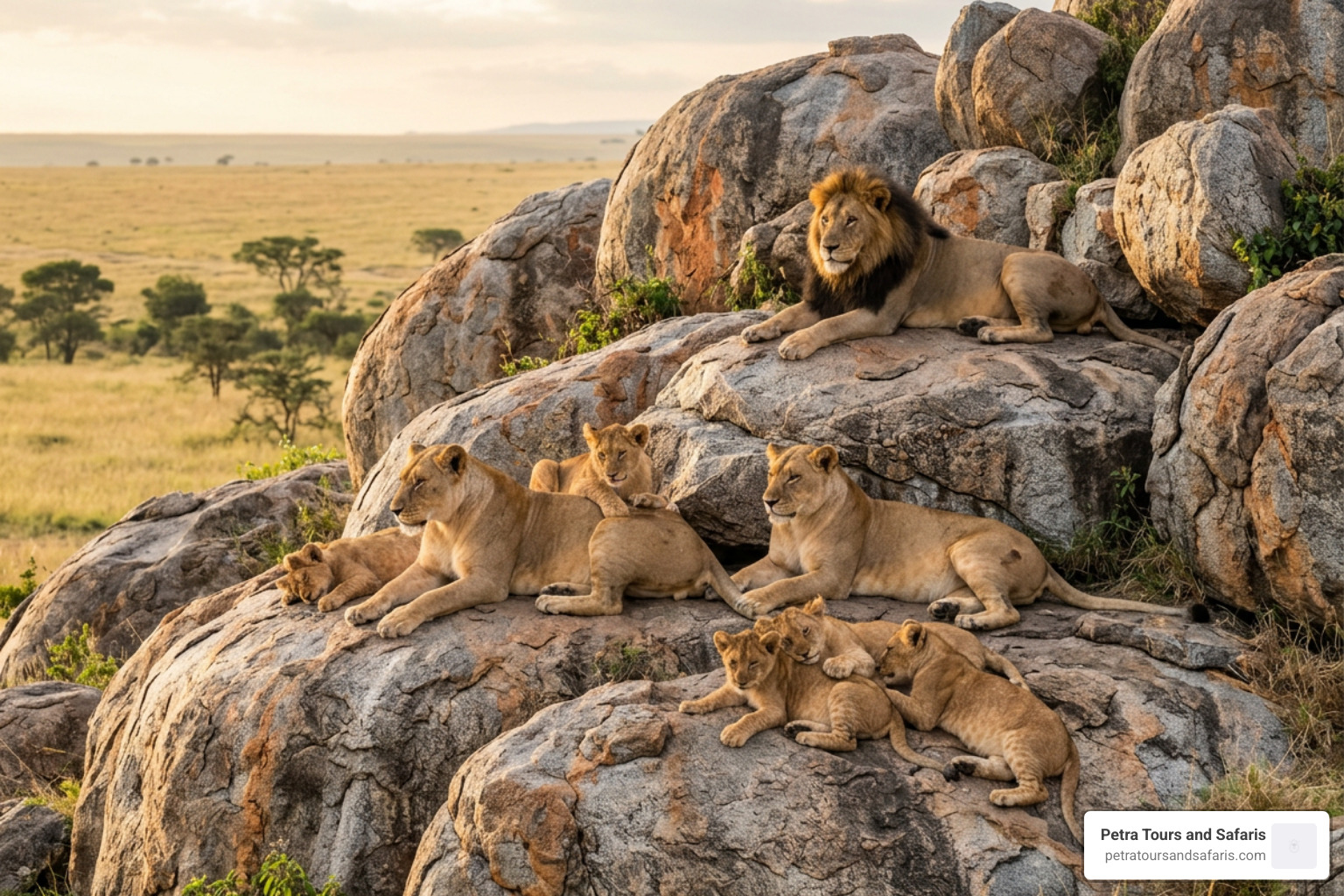
Across 14,763 square kilometers of protected wilderness, this ecosystem is home to Africa’s largest lion population, with over 3,000 individuals roaming the open plains, riverbanks, and rock formations. Alongside these apex predators, healthy numbers of leopards, cheetahs, spotted hyenas, and elusive African wild dogs maintain a delicate predator-prey equilibrium.
The park provides a vital stronghold for the classic African Big Five: lions, leopards, elephants, buffalo, and rhinos. Conservation measures have yielded remarkable turnarounds over the past several decades. The African bush elephant population, once decimated by commercial poaching in the 1980s, rebounded to over 5,000 individuals, while African buffalo numbers comfortably exceed 28,000.
The eastern black rhinoceros remains one of the park’s most critically protected residents. After poaching reduced the population to roughly 10 individuals in the late 20th century, dedicated anti-poaching units and intensive monitoring have enabled numbers to steadily climb, though fewer than 70 individuals exist in the park today. For a deeper look into the park’s administrative establishment and taxonomic diversity, explore this Serengeti National Park history and wildlife facts resource.
Birdlife in the Serengeti is equally breathtaking. Over 500 avian species inhabit the park, ranging from the world’s largest bird—the common ostrich—to endemic treasures like the Fischer’s lovebird, rufous-tailed weaver, and grey-breasted spurfowl. Secretary birds stalk the grasslands, while martial eagles and lappet-faced vultures patrol the thermal updrafts above.
The Great Migration Cycle and River Crossings
The Serengeti Great Migration is not a singular event; it is an endless, clockwork journey spanning roughly 800 kilometers across northern Tanzania and southern Kenya. Over 1.5 million western white-bearded wildebeest, 250,000 Grant’s and plains zebras, and roughly 400,000 Thomson’s gazelles move in a synchronized rhythm governed by rainfall and soil nutrients.
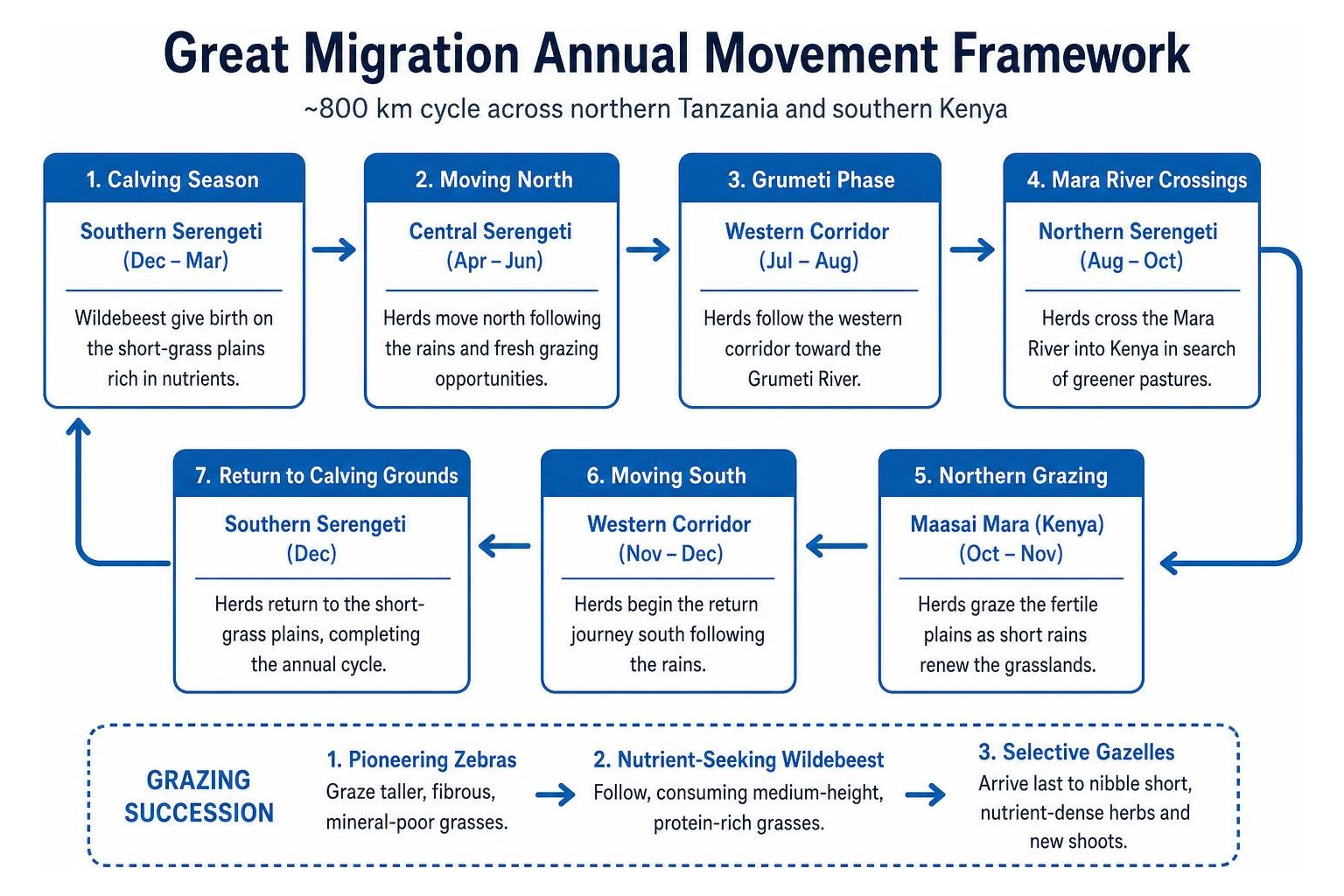
The grazing succession is an ecological marvel of cooperation:
- Pioneering Zebras: Zebras move in first to graze on the taller, fibrous, mineral-poor grass canopies, exposing tender shoots below.
- Nutrient-Seeking Wildebeest: Wildebeest follow closely, consuming the medium-height, protein-rich grasses.
- Selective Gazelles: Thomson’s and Grant’s gazelles arrive last to nibble on the short, nutrient-dense herbs and newly sprouted shoots left exposed.
Between January and March, the herds gather on the nutrient-rich southern plains around Ndutu for the synchronized calving season, where roughly 8,000 wildebeest calves are born daily over a three-week peak. By May and June, dry conditions push the herds northwest into the Western Corridor, where they encounter their first major aquatic hurdle: the Grumeti River.
From July through October, the drama peaks in the northern Serengeti as the herds brave the raging Mara River. Immense Nile crocodiles lie in wait, yet water currents prove deadlier still—statistically, for every wildebeest caught by a crocodile, roughly 50 drown in the chaotic stampedes. Around 250,000 wildebeest and 30,000 zebras die each year during the circuit from exhaustion, predation, disease, and drowning, providing a vital influx of biomass that sustains aquatic and terrestrial scavengers alike.
Geology, Climate, and Key Regions of Serengeti NP Tanzania
The physical foundation of the Serengeti dates back millions of years. Precambrian metamorphic bedrock forms the base, punctuated by iconic granite outcrops known as kopjes—ancient metamorphic islands rising above the flat savanna that serve as crucial lookout towers and shade havens for lions, leopards, and hyraxes.
The southern grasslands owe their extreme fertility to natrocarbonatite volcanic ash deposited by nearby volcanoes, primarily Kerimasi and Ol Doinyo Lengai (“The Mountain of God” in Maa). This ash weathered into calcitic hard-pan vertisols: shallow, nutrient-dense soils rich in calcium, phosphorus, and potassium. Because tree taproots cannot penetrate the hard-pan layer, the southern plains remain virtually treeless, expansive grasslands.
The park divides into three primary ecological zones:
- Southern Plains (Ndutu & Kusini): Wide-open short grass plains with high-phosphorus forage, ideal for calving herbivores from December to March.
- Central Serengeti (Seronera Valley): Riverine woodlands and open plains featuring permanent water sources, hosting the highest year-round density of leopards and lions.
- Western Corridor & Northern Woodlands: River systems (Grumeti, Mbalageti, and Mara) surrounded by dense acacia-commiphora woodlands, rolling hills, and deep gorges.
The climate is subtropical and semi-arid, influenced heavily by altitude (1,100 to 2,000 meters above sea level). The park experiences a bi-modal rainfall regime: the “short rains” from November to December and the “long rains” from March to May. Average annual rainfall varies from 900 mm in the drier south to 1,000+ mm in the northern hills.
Conservation, Anti-Poaching, and Community Stewardship
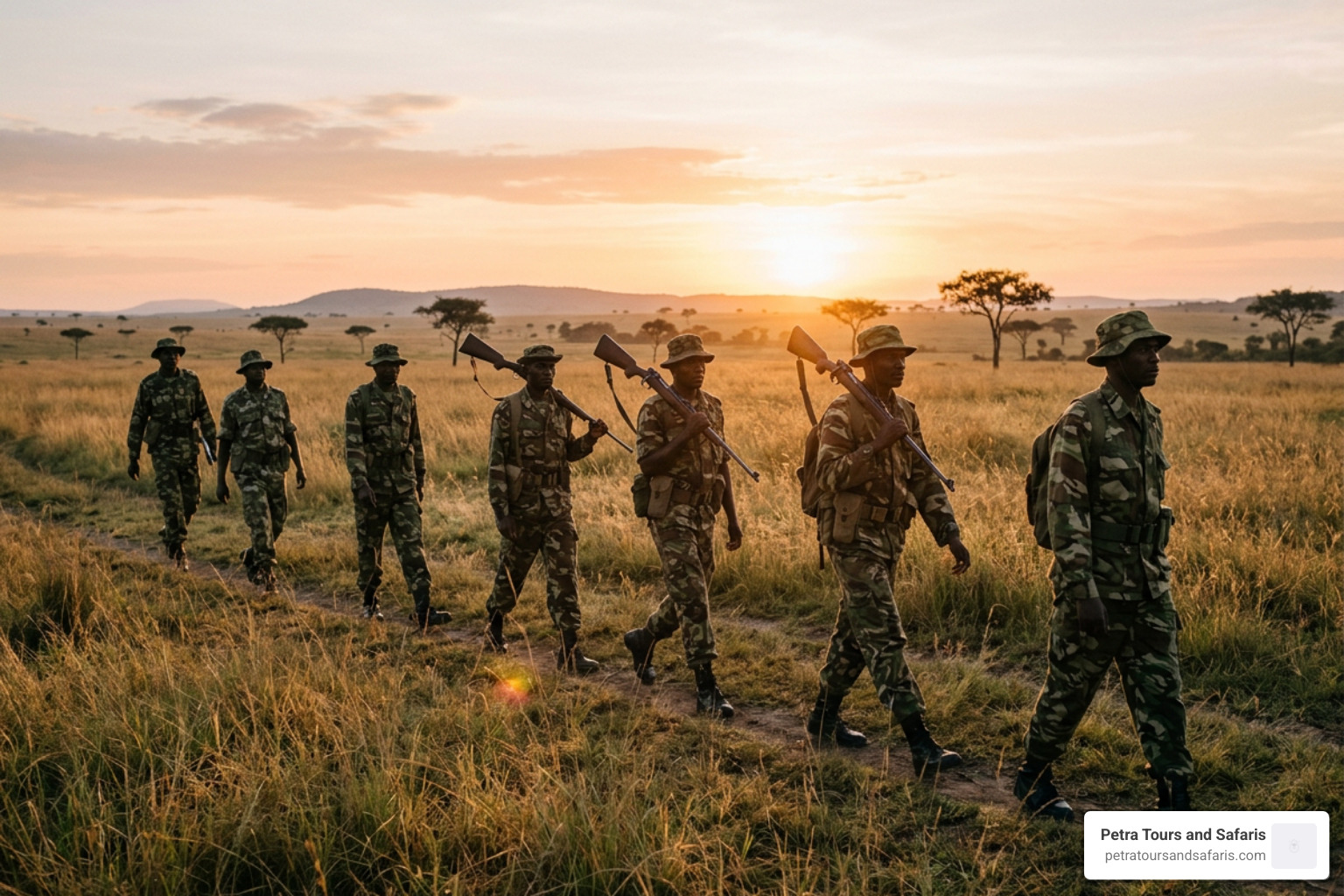
Preserving an intact landscape spanning nearly 15,000 square kilometers requires continuous collaboration. Tanzania National Parks (TANAPA) manages the park under strict conservation mandates, working in close partnership with international conservation organizations like the Frankfurt Zoological Society (FZS).
One of the cornerstone achievements of this partnership is the black rhino surveillance program in the Moru Kopjes. Specialized rhino ranger units monitor individuals using telemetry equipment, tracking VHF signals from small radio transmitters inserted directly into the rhinos’ horns. Supported by low-flying aerial reconnaissance planes and customized 4×4 patrol units serviced monthly at the Seronera central workshop, these rangers provide around-the-clock protection against illegal poaching.
De-snaring teams represent another critical frontline defense. Operating in conjunction with local communities and safari operators, community-led de-snaring patrols sweep high-risk corridors where commercial bushmeat hunters set wire snares. Since the initiative was launched, more than 100,000 wire snares have been discovered and dismantled, saving thousands of migrating ungulates and predators from slow strangulation. For deeper insight into official preservation guidelines, refer to TANAPA conservation strategies and park management.
Balancing Community Development and Threat Mitigation
The long-term survival of the Serengeti ecosystem depends entirely on the communities living along its perimeter. Recognizing that park borders cannot be defended through enforcement alone, conservation initiatives focus heavily on community empowerment:
- Participatory Land-Use Planning: More than 70 village communities bordering the park have created sustainable land-use maps, demarcating separate zones for agriculture, human settlements, livestock grazing, and wildlife transit corridors.
- Community Conservation Banks (COCOBAs): Micro-lending financial groups provide seed funding for villagers to launch eco-friendly enterprises, such as modern commercial beekeeping, sustainable poultry farming, and artisanal craft cooperatives. By generating alternative income streams, these programs reduce household dependency on illegal bushmeat harvesting.
- Human-Wildlife Conflict Mitigation: Constructing predator-proof livestock bomas and deploying chili fences or beehive perimeters to deter elephants from raiding community crops.
External ecological threats require ongoing vigilance. Deforestation in the Mau Forest headwaters in Kenya poses serious risks to the dry-season flow of the Mara River—the only permanent water source sustaining the migration.
Additionally, invasive plant species like Siam weed (Chromolaena odorata) and prickly pear (Opuntia) threaten native forage quality, while past proposals for commercial paved highways bisecting the northern migration corridors have spurred international campaigns to ensure transit routes are redirected south of the park boundary.
Safari Planning: Logistics, Activities, and Practical Guidelines

Planning an unforgettable safari requires aligning your travel window with the dynamic movement of the wildlife. While resident game viewing in the Seronera Valley is phenomenal 365 days a year, timing is everything if your dream is witnessing river crossings or calving.
| Month Range | Primary Migration Location | Key Wildlife Highlights | Safari Experience |
|---|---|---|---|
| January – March | Southern Plains & Ndutu | Wildebeest calving season; explosive predator hunts (cheetahs, lions). | Open plain game drives, dramatic predator-prey interaction. |
| April – May | Central Plains & Western Corridor | Herds assemble and move northwest; heavy green season rains. | Lush scenery, fewer safari vehicles, excellent birdwatching. |
| June – July | Western Corridor & Grumeti River | Grumeti River crossings; giant Nile crocodile encounters. | Transitional game drives, woodland tracking. |
| August – October | Northern Serengeti & Mara River | Iconic Mara River crossings; peak dry-season game densities. | Thrilling river crossing vigils, high predator activity. |
| November – December | North-to-South Return Transit | Herds head south following the short rains toward Ndutu. | Vibrant greening plains, dynamic herd movements. |
Beyond standard daylight game drives, you can explore the park through several specialized activities:
- Hot Air Balloon Safaris: Drifting at dawn above the acacia treetops before touching down for a champagne breakfast in the bush.
- Guided Walking Safaris: Entering designated wilderness zones in the northern or eastern sectors alongside an armed TANAPA ranger to study tracking, botany, and micro-ecosystems on foot.
- Picnic Stops & Natural Marvels: Stepping out safely at designated viewing areas like the Retima Hippo Pool, where hundreds of hippos jostle and wallow in dramatic social pods.
Essential Travel Rules and Visitor Tariffs for Serengeti NP Tanzania
Serengeti National Park operates under strict regulations designed to safeguard fragile ecosystems while ensuring visitor safety.
Entry Logistics & Airstrips: The park can be accessed by road via the Naabi Hill Gate (connecting from Ngorongoro), Ndabaka Gate (west), Ikoma Gate (central-west), or Kleins Gate (northeast). Alternatively, daily scheduled bush flights connect Arusha (ARK) and Kilimanjaro (JRO) to airstrips situated across the park: Seronera, Kogatende, Lamai, Kirawira, Kusini, and Lobo.
Tariff Structure:
- Non-resident adult conservation fees are set by TANAPA tariffs (typically $70–$80 USD per adult per day, subject to an 18% Value Added Tax).
- Permits operate on a 24-hour sleep-over basis for guests staying inside park accommodations or 12-hour basis for day visitors.
- Concession fees apply per person per night for lodging within park boundaries, and additional tariffs apply for vehicle entry based on tare weight.
Park Regulations & Safety Checklist:
- Speed Limits: Strictly enforced 50 kph maximum on main transit roads; lower speeds required during wildlife encounters.
- Off-Road Driving Restrictions: Off-road driving is strictly prohibited for vehicles with a tare weight exceeding 2,000 kg to prevent soil compaction and root damage.
- Gate Hours & Night Driving: Park gates operate strictly between 6:00 a.m. and 6:00 p.m. Driving between 7:00 p.m. and 6:00 a.m. is forbidden without special night permits in designated concessions.
- Wildlife Respect: Maintain a minimum distance of 25 meters from wildlife; never feed, harass, or make sudden noises around animals.
- Safari Packing Essentials: Pack neutral, khaki or earth-toned lightweight clothing (avoid dark blue and black, which attract tsetse flies), wide-brim sun hats, high-SPF sunscreen, quality 8×42 or 10×42 binoculars, a dedicated zoom lens camera, and malaria prophylactics.
Frequently Asked Questions About Serengeti Safaris
What is the best time of year to visit the Serengeti for the Great Migration?
The best time depends on the specific event you wish to witness:
- River Crossings: July to October in the Northern Serengeti (Mara River) offers the highest likelihood of witnessing dramatic river crossings.
- Calving Season: January to March in the Southern Serengeti/Ndutu Plains provides unmatched opportunities to see newborn calves and predator action.
- Resident Wildlife: June to October is the peak dry season, offering sparse vegetation and gathered waterhole wildlife viewing throughout the entire park.
How do conservation fees and entry permits work in the Serengeti?
All park visitors must obtain official TANAPA permits before passing entry gates. Entry fees for international adult travelers are charged per day plus 18% statutory VAT.
If staying inside the park at a lodge, permanent camp, or seasonal mobile tented camp, a 24-hour permit allows multiple entries and includes overnight concession fees. If camping publicly, special camping permits are required in advance. Payments at park gates are strictly cashless via international credit cards or authorized TANAPA payment cards.
How are endangered black rhinos protected in the Serengeti?
Black rhinos in the Serengeti are safeguarded through an intensive, multi-layered conservation strategy:
- Horn Telemetry: Radio transmitters inserted directly into rhino horns emit VHF signals tracked daily by rangers on foot.
- Dedicated Anti-Poaching Units: Specialized Rhino Ranger teams maintain 24/7 patrol coverage in key sanctuary sectors, particularly around Moru Kopjes.
- Aerial Surveillance: Regular light aircraft sweeps monitor rhino movements and inspect park boundaries for illegal human encroachment.
- Community Collaboration: Rapid-response intelligence networks work alongside border villages to preempt poacher incursions before they reach sanctuary grounds.
Conclusion
The Serengeti is not simply a travel destination; it is an enduring testament to what our natural world looks like when ecological systems are allowed to run wild and free. Every sunrise over the golden plains, every thundering river crossing, and every silent stalk of a leopard among the kopjes reminds us of the profound value of wildlife conservation.
At Petra Tours and Safaris, we take immense pride in crafting deeply personalized, ethically guided journeys across Tanzania. With our locally owned fleet, experienced Tanzanian safari guides, and deep commitment to sustainable tourism, we ensure your journey supports both regional conservation and local community development.
Whether you dream of following the Great Migration across raging rivers or listening to lion calls from the comfort of a luxury tented camp, start planning a customized Serengeti safari with us today.


